Wednesday, 30 January 2019

Taking Action and the Local Curriculum

That title almost sounds like a B-Movie title! I've been reading a bit of Rose Hipkins and her suggestions around capabilities that are across the NZC... a bit like the Key Competencies... but they're not... And yes, I get a little confused too!
The Ministry of Education is also ramping up its Local Curriculum PLD programme with a few PDFs in the last email sent through to us. Although IPL (the people I work with at the University of Waikato) are not part of the PLD being offered, we can of course still help schools with their thinking as well as exploring this as a part of the science PLD I can offer.
It's really got me thinking about a couple of aspects that I know are important in science but I spend a lot of time at the other end of the pool, supporting teachers in exploring the pedagogy of the nature of science and the science capabilities, so don't get to try out some of these deeper ideas. As I've thought more about this, I've started thinking Why aren't I playing with these ideas? Why have I decided that they really should be introduced later on rather than right at the beginning? So I decided to get going!
The first idea is Taking Action. Some science activities probably won't head down this track and I think that can be okay, however, we do need some science units that have opportunities for students to reflect on taking action, and perhaps even take action. It might not even be them that's taking action! I'm always intrigued that we have fossil beds in Aotearoa New Zealand that are kept secret. This includes fossil records of footsteps. We have very rare plants and animals that the location is not shared. These are ways people take action. Other ways are the current 'no plastic bags' movement that is growing across the country. Besides this, are there chances for students to, at the least, discuss ways they (or society) could take action? If I'm doing something around plants, I'll be doing some gathering and interpreting data as we observe different plants. I might do some planting (probably inside, out of the sun, at the moment!) and then gathering data of the plants growing, comparing to others' plant growth. I'll probably do some diagrams, cross-sections to focus on interpreting representations as well. But taking action? Maybe I could look at particular weeds issues -like gorse, which can be prevalent across the country. How are farmers and scientists taking action? What could we do? If I lived near native bush, I might get the students to explore the kauri die-back problem afflicting these mighty trees. How is society responding? How can we help? Could it happen locally?
Probable Plesiosaur vertebra: https://sites.google.com/site/hawkesbayfossils/home
The second idea is about our Local Curriculum. How can I connect my science unit to what's happening locally? I was chatting with one of my schools down Wairoa way and they were looking at 'doing dinosaurs'. Once upon a time, I used to put this in the Literacy box as I thought I can't stick the nature of science on a unit that's all about reading books! I've changed my tune these days and think dinosaurs is a great topic to show children all about inferences and using evidence. There's also lots of critiquing evidence to look at too -how do scientists handle it when their ideas seem to be wrong? Or they disagree with one another? Have our ideas changed over time? When the principal was talking about dinosaurs (and yes, I did interupt to ask what the big ideas were, what science capabilities were at the top!), I couldn't help thinking about the local curriculum: Dr Joan Wiffen was finding dinosaurs just down the road! Well maybe a little further inland... Connecting these children with these stories will excite them and engage them to dig deeper: What did Joan find? Are there still dinosaur bones there? Like a few other places, there are many shell fossils encased in sandstone and especially limestone in the Wairoa area -take the children somewhere to explore these riverbeds (which is where we usually find them). There's a local Hawkes Bay Paleontology Group that I might connect with to at least have an online chat with -How can there be Plesiosaur bones in the middle of the mountains miles from the sea?!?
With my plants unit, what's special about our own region? Are there any specialist people or companies around? Any rare plants? If I was in Rotorua, I might get the children inquiring about the Redwoods -I don't think we have any other forests of redwoods! If I was in the Opotiki region, I might get the children supporting beach sand-dune planting.
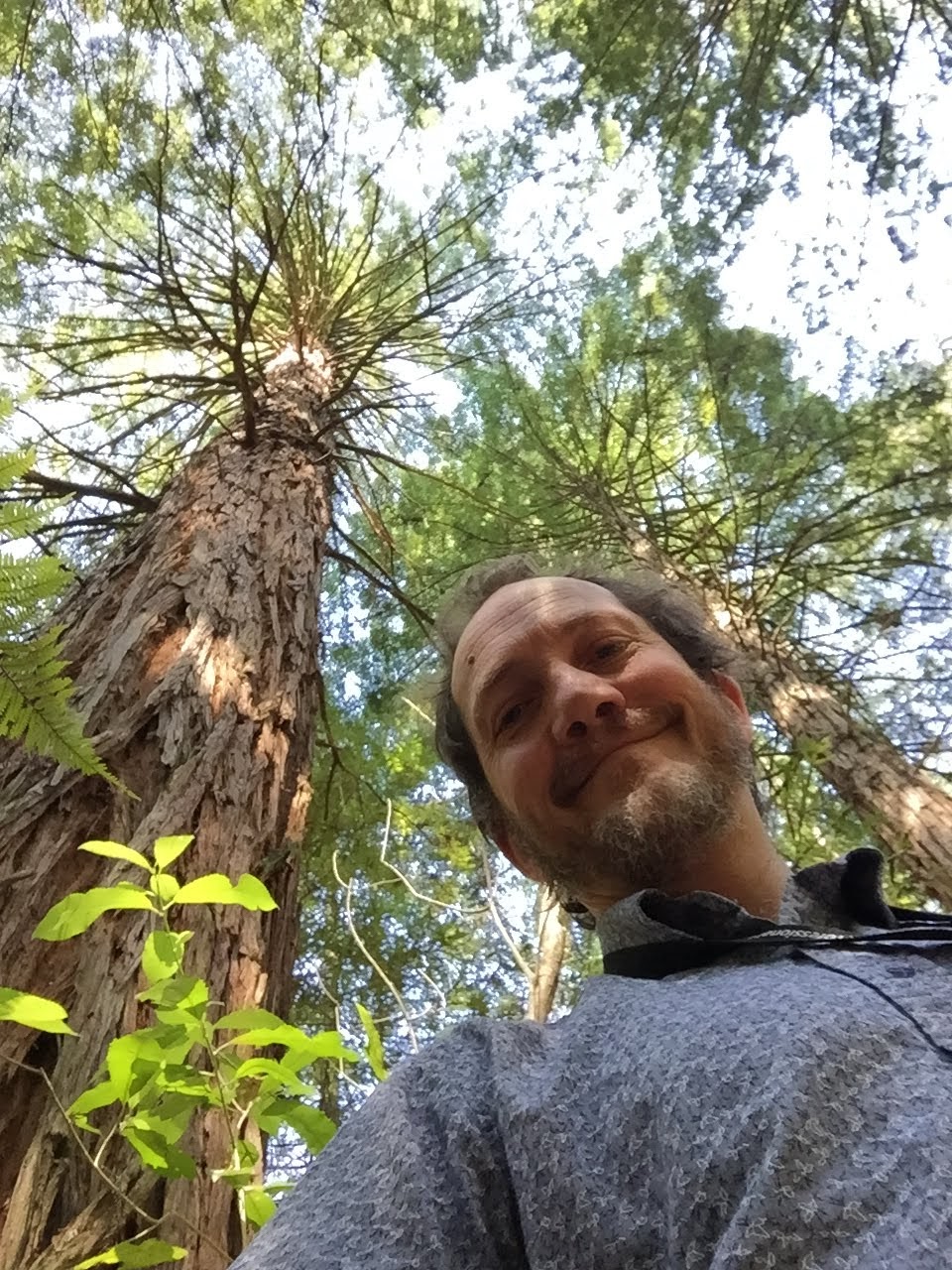
Me and a redwood... or should that be 'A redwood and I'?
And I haven't even started with thinking about the local community within the local curriculum! Are there special places to the local marae? I wonder if some of the trees may have names and narratives wrapped around them? Are there opportunities to explore tikanga Maaori at the same time? Are there local DoC offices that could share knowledge? Parents in the school?
So how am I taking action? I'm going to add a couple of new bits to my unit plans -Local Community and Taking Action. Sometimes there may not be anything to add here but with a bit more digging there might be! I was just thinking of an example that wouldn't have much to add here and thought about my ramps experiments but then wondered about 'Could there be local 'blackspots' where there are a lot of accidents? Could we use some science to wonder why?'!

Have fun and keep sciencing on! As always, I welcome your comments and questions -even if you disagree!
Paul


Thursday, 24 January 2019

Science Rich Tasks, and Context Knowledge

Happy New Year to everyone! 
I was reading an old SET article that a colleague had sent out -SET 2, 2011, What is a rich task? by Chris Joyce of NZCER. She was talking about assessment and the goal of rich tasks within this. It's an interesting read, as is anything published by NZCER. They write in a simple style that's easy to understand as well as encouraging.
There were a couple of bits that struck me that I wanted to share. I talk a lot about the nature of science with a focus on the science capabilities. I also talk about not being concerned if students don't quite get the context focus as first, I'm developing the capabilities and second, I'll simply provide some more opportunities to support that student's knowledge development. 
Sometimes it seems that I'm actually saying "Don't worry about all that context stuff, it's irrelevant"! However, it is important! If we are going to develop rich science tasks that challenge students, there needs to be context strand development. Even though the New Zealand Curriculum clearly states that the nature of science is the overarching strand and is the compulsory one, you can see that there's an expectation of students developing context strand knowledge as the Level 1 and 2 objectives are not the same as the Level 3 and 4 ones.
Joyce is writing about two different assessment tasks. One is simply expecting a knowledge answer and therefore isn't a rich task whilst the second task, one with a water filled balloon inside an air filled balloon is a rich task because there isn't simply 'an answer'. Children have the chance to share their own views and ideas giving teachers the chance to assess far more than a simple knowledge answer!
I like how Joyce writes about the melding of knowledge with the nature of science: 
Chris Joyce, Set 2, 2011
We need that knowledge so we can see how the student applies it to a nature of science centred assessment. He's using the science capabilities in observing, inferring, building an explanation and testing it. By having the context knowledge as part of the task, I believe that this task can be a rich opportunity to learn from (for the student and the teacher!).
The second thing I wanted to share is also about the purpose of the science task that we choose to give to students. These past couple of years, I've spent time in schools diving into the front end of the NZC to pull out those Key Competencies, Values and Vision aspects that can be supported by science. In fact last year I had a conversation about this very idea -a science lesson can have a focus on something other than science! It could be a tool to measure how students are operating in a Key Competency. Time for another Joyce quote: 
And now I'm wondering if I should write Key Competencies without capital letters! That aside, take a look through the front end of the NZC with your team. Underline or highlight all the bits that could be seen through a science task. You'll be surprised. At the end of the year, I often challenge staff to put all their science units that they have done alongside the Vision, Values and KCs. Sometimes the problem is we can think they've done 'everything' (and yeah, I know you actually do, in a way!) but I'm implying more of a deliberate act of teaching. How do we deliberately develop student thinking in terms of participating and contributing? Although it might be easy to assess with an arb task, it's a lot more difficult to support students in developing this idea. 

I like the idea that these rich tasks can be a part of a larger unit as well as smaller lessons which may be targeting a particular Key Competency or a science capability. It might be an evaluative lesson to gather some OTJ information so you are better equipped in planning further lessons. 
The other thing I like about these rich tasks are that they are perfect particularly for Term One! From my own experience, Term One has a pile of interuptions: Waitangi Day, swimming lessons, and formal assessments as well as new students turning up through the first few weeks. Being armed with a pile of rich tasks may be an effective way of getting through the term.

Have a great week everyone -I know you're all busy planning your first week as well as the term and I hope it all goes smoothly. If you have ideas for this year's blogposts, do share. I'm thinking of moving to a weekly blog but shorter pieces -I'd be interested in what you think of this idea. Do remember my facebook page which is also called Science Happening NZ. Here, I tend to post links, photos and videos to share ideas. It's a good place to message me too.
So onto 2019!

Monday, 3 December 2018

Headlines today: 4 out of 5 kids behind in science in science

This was the headline this morning when I read the news on my iPad NZ Herald app from the NMSSA (National Monitoring Study of Student Assessment) report. I wanted to share my thinking about the report.

The NMSSA reports are what NEMP used to be. People head around the countryside testing students in various curriculum areas and then these results are assessed at Otago University.

The article quoted Chris Duggan, House of Science, as stating that primary teachers lack confidence in teaching science and there is a 'huge lack of resources'. It was great to see that the study clearly disagreed with this. Teachers are confident, believe they have the resources they need, and are teaching science regularly. I was disappointed to see her also saying that science advisors are 'long, long gone' -we're not! The job description has changed a little ('facilitators' rather than 'advisors') and all across the country there are skilled, enthusiastic and able facilitators working with every type of school! Although in the 'old days', you simply rang up an advisor and one came out to support your teaching, there are still those opportunities today. Yes, it's a little more lengthy, but every school can apply every term for as many hours and as long as a period as needed for PLD customised to their needs.

The article stated that there are no assessments in science. NZCER have been doing a great job, first with the science engagement tool, and then with creating a Year 4-6 online assessment Science Thinking with Evidence (STwE). The Years 7-10 STwE continues to be useful to intermediates and secondary schools. Using the STwE, schools I have been working with have seen achievement being far higher than the '20%' NMSSA are suggesting are behind curriculum levels at a Year 8 level. NZCER also have the Assessment Resource Banks with a range of activities to support teachers in assessing science.

So what might be happening? Students are keen on science and reasonably confident. Teachers enjoy teaching science and believe that they are focusing on the nature of science strands as well as being confident in the context strands.

I know that the House of Science are doing a great job at getting science kits into schools and ensuring that everything in the kit is ready to go... rather than the good ol' electricity kit on the shelf with flat batteries and blown bulbs! The Sir Paul Callaghan Science Academy is working with teachers developing capability, as well as providing science resources. The Royal Society's Science Teaching Leadership Programme is also available supporting teachers in developing an understanding of how science works and then supporting teachers back in the classroom. Doesn't sound like there's a lack at all! Oh, and there are people like Anne Barker and myself working with schools too!

I left the Science Learning Hub until last on purpose... because I really like the changes they've made to become more effective in supporting teachers. You see, I'm not sure kits, unit plans and lesson ideas on their own are going to help teachers. It's about shifting pedagogies. The folk at the SLH not only share great resources, but they also host webinars and can give one on one advice. I think this is one of the big keys -we must be about the how we teach science, as well as the why, before focusing on the what!

So it's not going to work with just resource kits or people heading off for courses. It also won't work with just getting in great facilitators (!). And this is the second key -the doing science. The article talks about the crowded curriculum as well as the focus we've had on literacy and numeracy. So how do we ensure science is happening? Can we integrate it with reading and writing? Can maths lessons incorporate some science? This year, I've noticed a clear difference between the schools that are deliberately doing science and the schools that haven't had the time. The STwE results clearly show a better improvement to schools who set aside the time for science. Even though I might be working in both sorts of schools, the PLD and resources are simply not enough. We need to be clear about the need for science, the purpose of science and setting aside the time to do science. I'm happy that even the schools  I'm working with who don't manage to do a lot of science still see improvements in student achievement -it's just not as marked as schools that set aside time for science.

Finally, teachers need to know what science looks like at different levels. With a curriculum that has Levels 1 and 2 the same and Levels 3 and 4 the same or similar, as well as a set of science capabilities with no levelled expectations, it can be difficult to know what science might look like at different levels. The Assessment Resource Bank (arbs) and STwE can help with this. I tend to use the Progressions for literacy and mathematics as a starter, as well as getting teachers to look at the STwE questions to get some idea of what science might look like at different levels. Talking to the Year 9 science teachers can help too -what are their expectations? What would they like children to come 'ready and able' with?

I must admit being surprised at the results, particularly the Year 8 data but it does reflect international monitoring as well. I hope that it isn't quite that bad and certainly my work with schools doesn't show averages quite that low. I do think we need to be setting aside specific time to teach science, using resources (unit plans, kits, and people!) as well as understanding why we teach science, to continue to improve the achievement. Integration is part of the answer but not the only one. The most important one is already there: you teachers!

So, have a great break!
Thank you for reading these posts (if you're still here of course!) and I so appreciate your support, encouragement and enthusiasm as well as comments! Here's to a great 2019!!!

Paul

Thursday, 22 November 2018

Play, Explore and Deliberate Acts of Teaching

This week I've been in Opotiki modelling and co-teaching and having a lovely time with great teachers and a bunch of children who get very excited for science (although being a bit mad helps too -me, not the teachers!). I'm thinking this will be one of the last blogposts for the year. Can I just say thanks to those of you who have emailed me, commented in the blogs or chatted with me when I have visited schools. It really does help to know there is an audience out there that wants to connect and discuss this stuff further!
Two things really shone out for me from the lessons that I thought I'd share with you. 
The first was a lesson we did from the Connected Fact or Fiction article on Pseudoscience. We started with a science board whole class reading activity and then the next day did the experiment exploring how much fat is in regular chips and non-fat ones. What was interesting was watching the children carrying out the experiment. We had talked beforehand about being methodical and careful with measuring and doing the investigation and on the whole they were. However, watching the children reminded us of the need to be giving them more opportunities to carry out experiments by themselves with less input from the teachers i.e. reading the experiment carefully. We also talked about the deliberate acts of teaching that is needed to support students in reading and carrying out procedures. They may need to be taught how to read carefully through the steps, not skipping bits as well as reading why they are doing the experiment and the expected outcomes. Children may not necessarily get better just by doing lots of experiments -they may need chances to talk about how to do the experiment as well as why we need to follow the steps. I know it might not seem like rocket science (no pun intended!) but in the busyness of the lesson we can forget!
The second moment came from working with intermediate age children and Lego. They were investigating whether they could affect a vehicles travel speed or distance by adding weight or aerodynamics, etc -it was their choice of variable. We discovered that we hadn't left much time for 'play'. I had leapt straight into the lesson but the children wanted the chance just to play, pull apart the cars and rebuild them as well as do the experiment. Most didn't start with recording but if I mentioned it, they immediately grabbed a book and recorded the data well. The teacher and I ended up talking about whether we should have had a chance to 'play' first with the ideas, perhaps a half hour lesson but still encouraging that scientific thinking with their efforts and then the next day, doing the lesson again with an emphasis on scientific thinking and behaviour -which, when I asked the children during the lesson, were all well aware of -they were just too busy to remember! This did happen a little with the first lesson too -we noticed they were very excited perhaps because we hadn't done much of this kind of science before. All were keen on the experiment and were aware of how to act -they were just enjoying the lesson and the experience too much! 
Again, that whole idea of needing to allow children the chance to play and explore is really essential. As is the need to be deliberate about how we teach science so that they grow that understanding of what science is. I had a fantastic week at the school and watching the way all the children responded in science was heartwarming. I love it when the PLD is working!

As always, keep an eye on my Facebook page for pictures and videos and the odd extra idea, search for "science happening NZ". The latest lesson was sent out this morning all about paper flowers and capillary action. 

Keep on sciencing!
Paul

Thursday, 8 November 2018

A bit of a bouillabaisse but sort of about students being critical and thinking for themselves... I think!

And that might take the record for the longest title so far! This week's blog started with me talking with my colleague Anne about Is no science better than bad science? We were discussing some of the resources out there and how they could be used to promote better teaching and a higher understanding of science for students but just as easily be a 'formula' lesson that, at the end of it, children have sort of done science but may not be any the wiser in thinking about how science works and its particular style of thinking, action and communication.
I also had the chance to read a flaming competition after a facebook post writing about how the paperbags from Countdown reminded her of the 'old days'. One person was posting about how plastic bags were better and shared a link: http://www.allaboutbags.ca/papervplastic.html and this reminded me of the recent "Ban the straws" movement. I think it was on National Radio where two people were arguing this with one stating how important straws were from a medical care point of view and another asking whether this was the most important thing to focus on when reducing plastic use.
Whether these are right or not isn't the point of this blogpost. It's really asking Do we check science reported by the media or our friends? Do we accept that what someone says is 'right' straight away? I know that there have been times media have jumped on a bandwagon to report something only to find out a couple of days later that they got the wrong end of the stick. 
So with these examples, who's right? Do I just say plastic bags are bad because that's what my stuff app on my iPad says? Or the TV news? Who are the ones saying that it's bad? Do they have a particular view or bent that might be biased? How would I find out or know? One thing that I'm quite interested in is that whole 'fake science' thing. My son is adamant that the moon landings were faked despite the plethora of evidence that proves him wrong. I'm speaking tongue in cheek a little as he has the same amount of facts proving me wrong! So who is right? This isn't one of those we can agree to disagree because we either did land on the moon or we didn't!
A while ago I read an interesting article about a reporter who did a pseudo-science investigation into whether chocolate can help you lose weight and was surprised at the amount of media outlets that simply ran the story without delving deeper (https://io9.gizmodo.com/i-fooled-millions-into-thinking-chocolate-helps-weight-1707251800?IR=T). From memory only one interviewer asked about the methodology... I guess the rest were just wanting a good sound bite: Chocolate helps you lose weight (and who wouldn't!).
I remembered about some articles that showed how most science journals will only publish investigations that have positive results and how this is affecting the science that is happening -you have to make sure that you succeed to get published. I wonder how this might affect the quality of the science happening? You certainly wouldn't want to take risks. At the same time, I came across some articles about how people had managed to get papers published in science journals that were clearly fake. These journals required you to pay to be published and purported to be peer reviewed but again, how would you know? Maybe Starwars' the Force is real!
I sometimes use The Onion or Babylon Bee (which is Christian-based) to give articles to children that are very clearly fake. Feel free to email me if you'd like a copy. I use them more for Year 7 and 8 children but they have fooled teachers too. They look scientific and they have scientist's names on them so maybe they are true...
So wrapping this all up... How do we support our students to develop critical thinking skills? How do we support them to know how to be critical and what to look for when reading an article or investigating a bit further? With resources that arrive at school, how can I use them to grow this sceptism or critical thinking? How can I challenge what they find out after doing the various experiments?
As an aside, I wonder what questions they might have that weigh on them. I'm always surprised how deep children are in terms of 'the big issues' and if all they've heard is mum and dad or the tv news, how could they check or confirm these problems? Sceptism is certainly a part of the curriculum, and something I have in spades -and yes, you can feel sorry for people I chat with! The important bit is that I'll go off to check out claims and facts and I think we need to be helping our students do the same! If they are worried about Rotorua disappearing in an almighty eruption next year, how can we investigate this claim and check its veracity? 

Keep sciencing
Paul

Weblinks:
https://www.npr.org/sections/thesalt/2015/05/28/410313446/why-a-journalist-scammed-the-media-into-spreading-bad-chocolate-science
https://www.gizmodo.com.au/2018/02/fake-research-paper-based-on-star-trek-voyagers-worst-episode-was-published-by-a-scientific-journal/
https://www.gizmodo.com.au/2017/07/scientific-journals-publish-bogus-paper-about-midi-chlorians-from-star-wars/

Thursday, 1 November 2018

ECE to Juniors...

I know I write a lot about middles and seniors with science but I have had an interesting week and wanted to write a wee bit about juniors for a change!
This week I worked with some junior teachers exploring the idea of play-based learning within the context of science. We used the Te Whāriki curriculum as a starter as well as the website which has a bit more about science on than the actual printed curriculum seems to. We also had a couple of readings about junior themed science to use as a parallel alongside the NZC and Te Whāriki. 
It was a good conversation because the science capabilities reflect that idea of children inquiring, wondering and seeking answers which can be sen within a play-based learning context. For assessments, we thought the capability indicators that I have written could be worthwhile, choosing a dozen or so and rewriting to reflect a more junior-based programme, and then sharing OTJs on students as they participated in different activities. 
What sort of popped up in the conversation a little was what do we expect children at Year 1 and 2 to be doing in science? Not just the activity but also them -how should the capabilities look? What should teachers be expecting congnitively or behaviour-wise? This bit has ended up stuck in my head and I think it's a really important one for schools to be discussing. Do we expect the 5 year olds to be exploring sustainability or becoming kaitiaki? What do the experts think? What kind of foundations should the juniors teachers be supporting the children to develop?
Sometimes I think we can go a bit deep. I've walked into junior classrooms and seen particle theory, tectonic plates, and acids and alkali being addressed. I've also had some very deep conversations with these wee ones where I've had to end up trying to explain some pretty deep concepts to a 5 year old who grasped the ideas quite ably! For me, the phrase 'emergent understanding' pinched off an NZC poster well explain science at this level. 
Children will be exposed to lots of different ideas in science using all four context strands. They are encouraged to gather and start to interpret what they are noticing, as well as beginning to communicate their ideas and understanding other people's communications (for example, the good ol' Monarch butterfly life cycle!). They are encouraged to ask questions, to notice change, to be careful observers, respect the environment, be fascinated by bugs and birds, get excited about reactions (like baking soda and vinegar models of volcanoes!) and start to develop a scientific lens.
I'm not sure they need a lot of knowledge developing -I might leave that for the next levels to grow that. But I do want to catch hold of that awe and curiosity that children come to school with and nurture it. I want them to know I'm interested in what they have to say and I want them to be interested in what I want to show them! I might talk about this being 'science' but I might even leave that to the next levels up as well.
Yesterday, I got home from a trip to Rotorua and my wife was keen to share her experience of working with some wee ones using my cellophane fish (which incidentally is next week's lesson I'm emailing out!). They were all preschoolers and I was really interested in how they behaved. As she spoke, I was thinking about whether you could start to build an 'expectations' rubric of preschoolers, 5 and 6 year olds, etc... What was interesting was, for the whole, all the children were fascinated with the wriggling fish on their hand, but more the effect on them or what they were feeling. They giggled that it was 'tiggling me' but there were no questions or wonderings happening at all. One four year old put the fish on the table where it didn't work so stuck it back on his hand. Although my wife didn't use these as a science lesson but a fun ending to the Rainbow Fish story, I was curious as to how it would have gone had I been there. Could children had even grasped the concepts of I notice, I think, I wonder? She mentioned they were very ego-centric so perhaps science activities would need to reflect that too... how do you feel with that insect on your hand?, What do you think that tastes like? rather than getting to deep into what do you notice happening in the glass?... 
I'm certainly not an expert at ECE level and am very open to a discussion here but I can't help wondering if "I notice" is enough at this level. Perhaps "I think" could be introduced as children work through year 1 and 2, as well as starting to encourage asking questions. "I wonder" may be more appropriate to develop as a more formal science inquiry at Year 2 or 3. I think these are really important questions to be asking ourselves particularly with planning our science...

  • What do we want children to develop from this science lesson sequence?
  • What do we want children to develop as a science lens?
  • Are there any particular knowledge topics we think are important for a 5 year old?]
  • How could the science capabilities look at this level?

Anyway, just a bit of a musing and something I'd like to continue to pursue! I'd love to hear your views as well!

Keep on sciencing
Paul

Wednesday, 24 October 2018

Paleoart and DINOSAURS!!!

I have discovered the world of podcasting and love it! There are a few that I like (and I'm open to more -feel free to suggest!) and on the way back to work from Rotorua, I was listening to an episode from 99% Invisible about 'paleoart' which I found fascinating (as I usually do) as well as a great opportunity for our older children to learn about inference.
I know that's a skill that is taught in reading but can be a bit more difficult to understand in science. The TKI science capabilities website (www.scienceonline.tki.org.nz) talks a bit about the first capability Gather and Interpret Data by talking about the gathering data as directly observable or measurable whilst the interpreting data bit is making meaning of the observation. As soon as children start to explain something, it's usually an inference!
Anyway this week's podcast was about the art of drawing dinosaurs and looked at how they were first drawn which was as big, cumbersome creatures that never moved. In fact one picture I was looking at showed two dinosaurs comatose as well as biting one another!
https://99percentinvisible.org/episode/welcome-to-jurassic-art/
This has moved on to the current dinosaurs which are very fluid and, as one person said, looking shrink-wrapped with lots of muscles as if they headed off to the gym three times a week. Jurassic Park has sort of followed this model, particularly in the early days.

https://99percentinvisible.org/episode/welcome-to-jurassic-art/
Now people drawing dinosaurs is changing again, and here's the inferences bit... We really have no idea what the dinosaurs really looked like. We do have some fossils with remains of muscles, fat and scales on. We also have fossils with what looks like proto-feathers on. But we don't know whether all dinosaurs had all of these! If you look at modern mammals, there's quite a wide selection even in the same type of animal! So this has given artists leeway to experiment. Here's what a dinosaur may have looked like that lived in the colder regions: 
http://markwitton-com.blogspot.com/2013/01/skin-deep-one-skin-fits-all-approach-to.html
I think this is interesting for two reasons. One, it can support children in being a little more critical of dinosaur art... How can the artist be sure it was purple with yellow stripes (which a dinosaur big book that I had in my classroom did!)? How can I be sure it didn't? If I want to infer, can it just be my imagination or does it need to be justified? So what does inference really mean then? Secondly, it can help children really get their head around observation and inference. We can work out that a triceratops had three horns and the shape of it's skeleton. We may also be able to tell how long the tail may have been... well, at least the bones bit! But the rest is inference! It may have had quills on the top of its head. It might have had a bright red frill... Could children look at a picture and a fossil and work out the observation and inference bits?
The podcast and a couple of the articles talk about what we might think modern animals may look like to the future paleontologist -there won't be an elephant trunk fossil, camel hump or the blubber of a whale to show them what these creatures really looked like. In fact how do we know the dinosaurs didn't have a big hump?
I love the picture of swans they draw as I already think of them as violent creatures!
One has speared a tadpole, neither have feathers or wings as they didn't fossilize...
The articles are quite interesting and I think this would make a great reading activity for the children. If I was to do it, I would draw the science out of this... So what are we learning about science? My daughter knows I'm quite the critiquer and has become one herself. Recently, she watched a BBC dinosaur clip and paused it to tell me that the commentator was talking about the behaviour and appearance of the dinosaur as if it was true rather then "We believe that these particular dinosaurs played guitar late at night whilst wearing sombreros" (and I so want to find this as a picture!). This is what we want for our children: to learn how media report science, how science actually is, and what observation and inference are.
Do the inferences mean that the artist is wrong? Not necessarily, but we need to explain why we have drawn particular features. Although I remember the older dinosaur books having some pretty exotic colours, I never really thought it was legit... I sort of thought they'd be more camouflaged and I didn't think trees would be those colours. Mind you, they might have been anyway! I do remember that early efforts to model the iguanadon were completely wrong due to putting the fossil together incorrectly -could this still happen today?
So, have a read of some articles, look at some of the pictures, have a go at drawing the creature that would fit a particular skeleton (like a whale, camel or rabbit) without sharing what the creature is and then get the children to justify their efforts. They might even like to have a go at drawing what a dinosaur might have looked!
Here's some of the places I went:
https://blogs.scientificamerican.com/tetrapod-zoology/dinosaurs-and-the-anti-shrink-wrapping-revolution/
http://markwitton-com.blogspot.com/2013/01/skin-deep-one-skin-fits-all-approach-to.html
https://99percentinvisible.org/episode/welcome-to-jurassic-art/ (This is the podcast one -I would certainly recommend it for the children to listen to as it is a safe one with some interesting ideas... and I like the idea of students listening to podcasts!).
I had to finish with this picture just because it looks lovely! Apparently most art of dinosaurs usually had them eating or fighting and this was one of the first pictures of them sleeping (although I'm wondering if they might have slept standing...).
https://blogs.scientificamerican.com/tetrapod-zoology/all-yesterdays-book-and-launch-event/

So enjoy!
Keep on sciencing!

Paul